The Faroe Islands Aren't Undiscovered, But Nothing Can Prepare You for How Strange They Actually Are
A first-timer's practical Faroe Islands guide. Atlantic tunnels, hovering lakes, puffin colonies, and logistics that actually help.
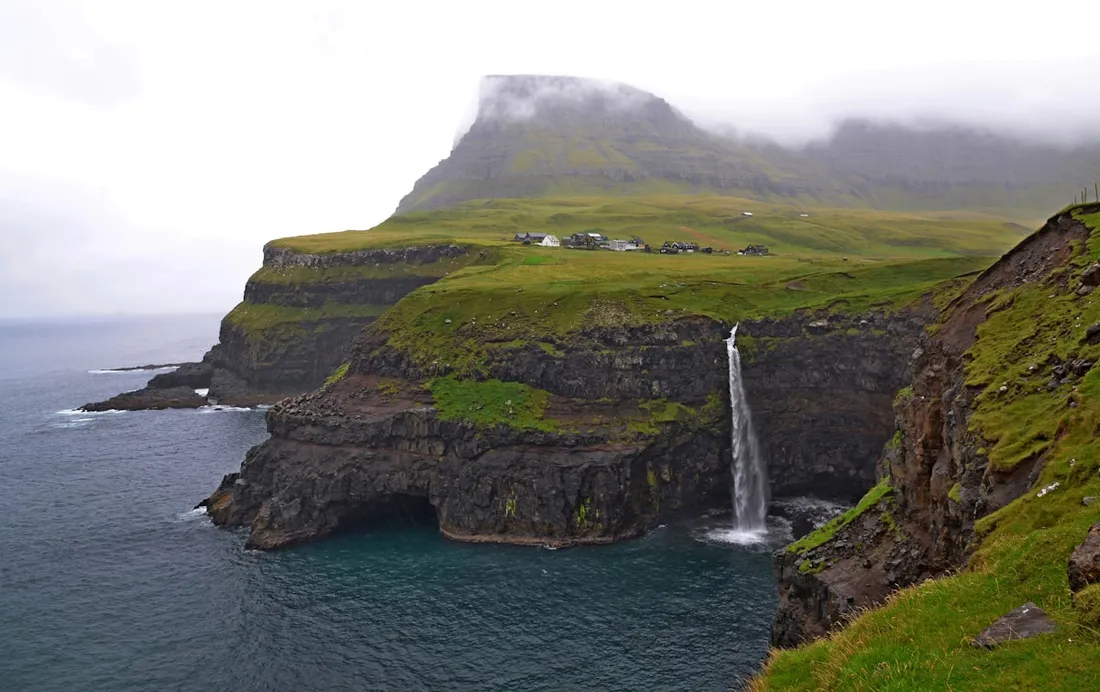
I’d seen every photo. The grass-roofed villages clinging to cliffsides. The waterfalls pouring directly into the Atlantic. The lake that appears to float a hundred meters above the ocean. I’d scrolled through all of it, saved half of it, and figured I knew what I was walking into.
Then I drove through an underwater tunnel between two islands and came out the other side into a wall of fog so thick I couldn’t see the hood of my rental car, and I realized I hadn’t understood a single thing about this place from my phone screen.
The Faroe Islands aren’t a secret. They haven’t been for years. Every travel publication has run the “Europe’s last undiscovered destination” headline at least twice. But here’s the thing nobody mentions in those pieces: the Faroes don’t need to be undiscovered to be extraordinary. They’re extraordinary because the physical experience of being there (the scale, the weather, the way the landscape shifts between alien and pastoral every fifteen minutes) genuinely can’t be replicated by a photograph. The photos are accurate. They’re also completely inadequate.
Every Photo You’ve Seen Is Accurate. All of Them Are Inadequate.
The problem with Faroe Islands content isn’t that it’s wrong. The grass-roofed houses in Gásadalur really do look like that. Múlafossur waterfall really does fall directly into the sea. The cliffs on Vestmanna really are that vertical.
The problem is that photos strip out the three things that make the Faroes feel like another planet: the wind, the speed of the weather, and the silence between gusts.
I stood at the Múlafossur viewpoint on my second day and watched the wind redirect the waterfall sideways. Not a little. Fully horizontal, the water arcing away from the cliff face and dissolving into mist before it reached the ocean. That lasted about forty seconds. Then the wind shifted, the falls dropped straight again, and a cloud moved across the valley so fast it looked like someone had hit fast-forward. Within five minutes I’d seen three completely different versions of the same view.
You can’t Instagram that. You can’t even really video it, because the camera doesn’t register the cold cutting through your jacket, or the way the grass sounds when the wind flattens it, or the smell, this constant, low-level salt-and-wet-earth scent that follows you everywhere on the islands. The Faroes are a sensory experience that happens to be photogenic. Most people only encounter the photogenic part.
What Makes the Faroes Genuinely Strange, Not Just Beautiful
Iceland is dramatic. Norway is dramatic. The Scottish Highlands are dramatic. I’ve driven the Ring Road in Iceland and felt that same sense of scale, that same “the earth is showing off” energy.
The Faroes are different. The Faroes are weird.
Eighteen islands, connected by tunnels blasted through undersea rock, with a combined population smaller than most mid-size towns. Roads that switchback through mountains and emerge above cloud level, so you’re literally driving above the weather. Villages of forty people tucked into valleys that feel like they were placed there by someone who didn’t want them found. Sheep that outnumber humans roughly two to one, standing on cliff edges with a calmness that suggests they know something you don’t.
The Vágar undersea tunnel is the thing that broke my brain. You drive down, steeply down, into a tunnel that runs beneath the Atlantic Ocean between Streymoy and Vágar islands. The walls are raw rock, the lighting shifts from yellow to blue at the roundabout at the bottom (yes, there’s a roundabout at the bottom of the ocean), and the whole thing feels less like driving and more like being swallowed. I came out the other side and pulled over not because I needed to but because my sense of spatial reality needed a minute to recalibrate.
Then there’s the fog. I was driving from Tórshavn to Saksun on a road that climbs through a mountain pass, and the fog descended so fast I went from full visibility to maybe ten meters in under a minute. I pulled over, turned on my hazards, and sat there. Not anxiously. It happened too quickly for anxiety. More like acceptance. The wind rocked the car. The fog pressed against the windows. I could hear sheep somewhere off to the left but couldn’t see them. Twenty minutes later it lifted as fast as it had arrived, and the valley below was bright green and completely clear, like nothing had happened.
This is what the photos don’t tell you. The Faroes aren’t a backdrop. They’re an active participant in your trip, and they don’t care about your itinerary.
Can You Actually Do This Without a Rental Car?
Short answer: technically yes. Practically, no.
The Faroes have a bus system (Strandfaraskip Landsins) and it connects the major villages on the larger islands. There’s also a network of ferries and those undersea tunnels. But routes are infrequent, especially outside summer, and the places that make the trip worth taking (Saksun, the Sørvágsvatn trailhead, the Gásadalur viewpoint) aren’t on main bus routes or require a hike from the nearest stop.
Rent a car. This isn’t negotiable. The roads are well-maintained, largely empty, and the driving is straightforward, you’re just going to deal with single-lane stretches, sheep crossings, and occasional fog. Stick to daylight hours, don’t speed (speed cameras exist and the fines aren’t cheap), and pull into passing places to let oncoming traffic through. If you’ve driven in rural Scotland or the west of Ireland, you’ll be fine.
62cars and Unicar are the two main rental agencies in Vágar. Book early for May–June, there aren’t many cars on the islands to begin with, and availability drops fast. Expect to pay 550–750 DKK ($80–110 USD) per day for a basic hatchback. Get the gravel insurance add-on. Some of the roads to smaller villages are unpaved, and a rock chip on the windshield will cost you more than the insurance.
Getting there: Atlantic Airways flies from Edinburgh (1 hour 25 minutes, shorter than most domestic flights), Copenhagen (2 hours), and seasonally from a handful of other European cities. From Edinburgh, round-trip flights in May–June run around £180–260 ($230–330 USD) if you book 6–8 weeks ahead. Copenhagen is the more frequent hub, and if you’re already moving through Europe on the continental train network, getting to Copenhagen by rail and flying from there is the cleanest routing.
Vágar Airport is tiny. One baggage carousel. You’ll have your rental car keys and be on the road within twenty minutes of landing. This is not an exaggeration, the airport is roughly the size of a large Starbucks.
Sørvágsvatn: The Lake That Appears to Hover Above the Sea
This is the image you’ve seen. The one that made you look up the Faroe Islands in the first place. A lake that appears to sit on a cliff shelf, dramatically elevated above the Atlantic, with a waterfall spilling over the edge. It looks like a Photoshop error. It looks like gravity got confused.
Here’s what nobody tells you: the optical illusion only works from one specific angle, and that angle requires a 45-minute hike from the car park near the village of Miðvágur. The trail isn’t hard, gently uphill on a well-worn path through grass, but it’s exposed. Fully exposed. The wind will be in your face for most of it, and if it’s been raining (it’s been raining, it’s always been raining, there’s roughly a 70% chance it’s raining right now), the path is slick.
But when you reach the viewpoint and look back at the lake from the right position, the illusion locks into place and your brain genuinely struggles. The lake IS above the ocean. You can see it. It’s maybe 30 meters above sea level, but from this angle, with the cliff face hidden by the perspective, it looks like it’s hovering at 200 meters. The waterfall, Bøsdalafossur, drops from the lake’s edge directly into the Atlantic below, and the scale is so wrong-looking that you keep blinking, trying to catch the trick.
You can’t. It’s real topography doing something your visual system wasn’t designed to process.
Logistics: The hike is managed, and as of 2025 there’s a 200 DKK ($29 USD) entrance fee per person, payable online at visitvagar.fo or at the trailhead. A guide isn’t required but is available. Go early morning, by 10am in peak season, the path gets busy. Give yourself 2.5–3 hours round trip including time at the viewpoint, longer if the wind is aggressive (it will be aggressive).
Mykines: Puffins, Vertigo, and When to Book the Guided Path
Mykines is the westernmost island, and it’s where the puffins are. Thousands of them, nesting in burrows along the cliff edges, completely unbothered by humans, looking exactly as ridiculous in person as they do in photos. Like someone designed a bird as a joke and it turned out to be real.
The ferry from Sørvágur to Mykines takes about 45 minutes and runs once or twice daily depending on the season, and it cancels frequently due to weather. This is important. Don’t put Mykines on your last day. Don’t put it on a day where cancellation ruins your trip. Build in a buffer day. I planned for Mykines on day three of five and got lucky with calm seas. The couple at my guesthouse had tried twice and been turned back both times.
The island itself is a single village of maybe ten permanent residents, connected by a trail to the Mykineshólmur islet where the main puffin colony nests. The trail runs along cliff edges that are genuinely vertigo-inducing, not in a fun way, in a “the ground drops 200 meters to the Atlantic and there’s no railing” way. The final stretch crosses a narrow land bridge to the islet with the lighthouse, and in high wind (assume high wind), it requires focus.
Since 2024, access to the puffin colony and the path to Mykineshólmur requires booking a guided slot through visitMykines.fo. Slots are limited and sell out weeks in advance during May–June. Book the moment your flights are confirmed. The fee is 350 DKK ($51 USD) and includes the guide. It’s worth it, the guides know exactly where the nesting burrows are and keep groups from trampling habitat.
Puffin timing: They arrive in late April and leave by mid-August. Peak viewing is mid-May through June. By July the colonies are thinning. By August they’re mostly gone. This is one of the reasons the May–June shoulder window matters.
The smell on the cliffs is something else. Salt spray, wet grass, and a sharp, fishy undertone from the nesting birds that hits you before you see a single puffin. Then you hear them, a low, mechanical buzzing from the burrows, like someone left a phone on vibrate underground. Then you see them, and they’re just standing there, orange beaks pointed into the wind, looking like confused little professors.
I sat on the grass ten feet from a puffin for twenty minutes. It looked at me once, decided I wasn’t interesting, and went back to staring at the ocean. Best twenty minutes of the trip.
Where to Stay Without Booking a Converted Fish Factory
Look, the Faroes don’t have a massive accommodation scene. The total tourist infrastructure is modest, which is part of the appeal and part of the challenge. You’re not choosing between fifty hotels. You’re choosing between a handful of guesthouses, a couple of proper hotels, and some Airbnbs, and in May–June, even those fill up.
Tórshavn is the capital and the obvious base. It’s a town of about 14,000, which makes it feel almost cosmopolitan by Faroese standards. Stay here for at least two nights. Hotel Føroyar is the splurge option, perched above the city, grass roof, floor-to-ceiling windows overlooking the harbor, around 1,600–2,200 DKK ($230–320 USD) per night. It’s one of the few hotels that genuinely earns its price through the view alone.
For something more reasonable, Guesthouse Hugo in central Tórshavn runs about 800–1,100 DKK ($115–160 USD) for a double. Clean, simple, and the owner makes breakfast that includes smoked salmon and rugbrød (dense rye bread) that I’m still thinking about. There’s also Bládýpi Hostel, which is the only real hostel option in town, dorm beds around 350 DKK ($51 USD). It’s small and books fast, but the common room is good and the location is walkable to the harbor and Tinganes (the old town peninsula with the red parliament buildings).
On Vágar (near the airport, Sørvágsvatn, and the Mykines ferry), Guesthouse Bøsdalafossur in Miðvágur puts you within walking distance of the lake trailhead. Around 900–1,200 DKK ($130–175 USD) per night. Not fancy, but the rooms are warm, the wifi works, and the host will tell you exactly which weather window to aim for on the hike.
The food situation: Tórshavn has genuinely good restaurants, this surprised me. KOKS is the famous one, a Michelin-starred spot that relocated to the islands and serves Faroese tasting menus built around fermented lamb, dried fish, and sea herbs. It’s an experience, and it’ll run you around 2,200 DKK ($320 USD) per person with the wine pairing. I didn’t go. That’s two and a half days of my accommodation budget. Instead, I ate at Ræst in Tórshavn, which serves traditional Faroese food, ræstkjøt (wind-dried fermented mutton) that smells like a barn and tastes like the most intensely savory thing you’ve ever put in your mouth. A main course runs 180–280 DKK ($26–41 USD). Get the lamb. Also get the ræst fiskur (fermented fish), even if the smell makes you hesitate, because you didn’t fly to the middle of the Atlantic to eat something safe.
For cheaper eating, Fiskastykkið near the harbor does fish and chips with whatever was caught that morning, usually cod or haddock, for about 120 DKK ($17 USD). The batter is light, the fish is so fresh it barely tastes like fish, and you can eat it on the harbor wall watching boats come in. That’s lunch sorted.
Daily budget if you’re being smart: 1,400–1,900 DKK ($200–275 USD) including car rental, guesthouse accommodation, and eating well. Not cheap. The Faroes aren’t a budget destination, this isn’t Southeast Asia. But for what you’re getting, it’s reasonable. I’ve spent more per day on the Amalfi Coast and had a fraction of the experience.
The Right Window: Why May–June Beats High Summer
July and August are when most people visit the Faroes. They’re wrong. Not completely wrong, the weather is marginally warmer and you’ll get the longest daylight, but May and June are better, and here’s why.
Puffins. They’re at peak numbers in May and June. By late July, they’re already starting to leave.
Light. In June, the Faroes get nearly 24 hours of daylight. Not midnight sun exactly, you’re not quite far enough north, but a sustained golden twilight that never fully darkens. I drove back from Saksun at 11:30pm and the sky was still lit, this pale amber glow along the northern horizon that turned the grass almost neon green. Try doing that in August when it’s dark by 10pm.
Crowds. The Faroes get around 120,000 visitors a year, not massive, but concentrated. July–August accounts for the bulk of it. In late May, I had the Sørvágsvatn trail nearly to myself on a Tuesday morning. The Mykines ferry wasn’t full. Restaurant reservations in Tórshavn were day-of, not weeks in advance.
Weather. Here’s the honest part: the weather in May is unpredictable. It’ll rain. It’ll be cold, expect 5–10°C (41–50°F), dropping lower with wind chill. You’ll need waterproof layers, not a light rain jacket. A proper shell, waterproof hiking pants, and base layers. I packed wrong, brought a mid-weight rain jacket that soaked through on day two, and ended up buying a proper waterproof shell at a sports shop in Tórshavn for 900 DKK ($130 USD) that I should’ve packed in the first place. (One bag. I’ve said it before, read the packing post. But for the Faroes, make sure that one bag includes serious rain gear.)
Booking window: For May–June 2026, book flights and accommodation by late March. The rental car by early April at the latest. The Mykines guided slots open in rolling batches, check visitMykines.fo starting in March and grab the first available dates that match your trip.
One more thing nobody tells you: the Faroes close on certain days. Literally. There’s an annual maintenance and conservation closure, Løgting (parliament) occasionally designates days when tourist sites close for environmental restoration. Check visitfaroeislands.com before finalizing dates. Getting there and finding Sørvágsvatn closed would ruin a day you can’t get back.
The Part Where I Tell You to Go
The Faroes aren’t the kind of trip you take for relaxation. They’re the kind of trip you take because you want to feel small in a way that doesn’t happen at a resort. The landscape doesn’t care that you’re there. The weather doesn’t cooperate. The puffins don’t look up. And somehow, standing on a cliff edge in horizontal rain, watching a waterfall blow sideways while sheep graze behind you like nothing’s happening, that’s the most alive I’ve felt since a plastic table in Chiang Mai with a bowl of khao soi.
You don’t need this trip to be a secret. You just need to show up and let the place be as strange as it actually is. Skip the weekend city break for once. Fly to a rock in the North Atlantic. Drive through an underwater tunnel. Sit with a puffin. Let the fog win.